
Wednesday, March 18, 2015
Introduction
Welcome to my blog. For those of you who don't know me very well, I have always been fascinated with Biblical history. Whether you believe the Bible is a divinely inspired document or not, the fact remains that it is one of the best (if not the best) selling books of all time. I have never really explored the Bible through the lens of book history, but that is what this blog is for. I hope you learn something and enjoy reading the blog. Quick explanation about the survey at the bottom of the blog: I chose two popular verses, but I would be interested in what your favorite verse is if it is not one of the two listed. If you select that choice, please comment on this post and let me know what your favorite verse is.
Also, I understand that the Bible and religious issues in general can be a touchy subject. This blog is not meant to forcibly inflict my personal beliefs upon anyone (though I'm more than happy to discuss those in a different setting if a reader has questions, just email me). Rather it is a means to present factual research about the Bible in relation to how it functions as a book, just like we have been discussing in class. I think you find what follows to be interesting and, hopefully, enjoyable. Thank you for taking the time to read through the blog!


The Bible as a Book (A Brief History of the Formation of the Bible)
In an article written for pbs.org, William Schniedewind, author of How the Bible Became a Book, provides an overview of how the modern Bible transitioned from an oral tradition to a textual document. He states that the turning the Bible into a book was a sign of the cultural growth and spread of literacy that took place between the eighth and sixth centuries B.C. Up to this time the ability to write (and read) was reserved largely for religious leaders. This reinforced the power religion held over the general populace. However, as the the Jewish culture became more educated, knowledge of the religious texts became more accessible to those who were not a part of religious leadership. Furthermore, the onset of Christianity solidified the need for written Biblical texts. Schniedewind writes, "Christianity, however, quickly adopted the codex—the precursor of the modern book. Codices, with bound leaves of pages, appeared in the first century A.D. and became common by the fourth century. The codex could encompass a much more extensive series of texts than a single scroll could contain. In bringing together a collection of scrolls, the codex also defined a set and order of books and made possible a more defined canon. It was with the technological invention of the codex that the "Bible" as a book, that is, the Bible as we know it, first got its physical form." Since the fundamental message of Christianity is taught to be for everyone, it makes sense that religious texts would be made accessible through writing so that it could be easily understood by everyone.

While Wikipedia is not always the best source of information, it does provide a decent overview of the canonization of the Bible as we know it today. It was a lengthy process of deciding what religious writings would be included, as it took several centuries before the modern Bible was established. Of course there still exists debate over this topic today, but this blog is not dedicated to that debate. What is important for the sake of this blog is that Athanasius, the Bishop of Alexandria, included a list of 27 written works that would eventually become the New Testament in his Easter letter in 357 A.D. This list of books gradually became accepted and began appearing with the Old Testament as a collected work.
The Gutenberg Bible, printed in 1456, was the first Bible printed with moveable type.
Obviously, this is a quick overview of how the Bible came to exist as a book, but hopefully you can see how it transitioned from an oral tradition to the book we know today.
Sources:
http://en.m.wikipedia.org/wiki/Development_of_the_Christian_biblical_canon
http://www.pbs.org/wgbh/nova/ancient/origins-written-bible.html

Studying an unfurled biblical scroll

Early Biblical Codex
The Bible as an Artifact
I have already touched on how the Bible has existed in different forms over time (scrolls, codex, etc.), but for the purposes of this posting we will focus on the modern Bible. The modern Bible is printed like any other book. It is comprised of all the physical properties a book should have: front cover, possible dust jacket if its a hardcover, spine bindings, and PAPER! To me, the paper is where we start to see recognizable differences between the Bible and many other books. Due to the fact that the Bible is a large book to begin with, it is printed on very thin paper (Man is it easy to tear) to make the overall size of the bible a little more manageable.
The overall book structure of the Bible is also very recognizable. It will often come with title pages, copyright information (more to follow on this in another post), a table of contents, chapter/book headings, and many appendices/glossaries/maps. Of course the elephant in the room in this section of the Bible as an Artifact is the text itself. Similar to the paper, the text is typically set very small so as to cut down on the bulkiness of the Bible. They do make large print editions of the Bible, but most often the text is small and printed in a column fashion to make the most of the page space.
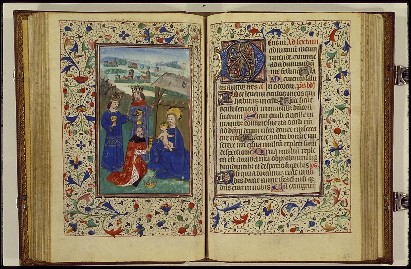
Bibles can also be illustrated. This is especially common today in children's Bibles. I still remember the artwork from my first Bible (see image below). However, Bibles have been illustrated in some fashion long before children's bibles even existed. These were known as illuminated Bibles. The Bibles were inscribed by hand and then "illuminated" with artistic designs and illustrations. Original illuminated Bibles still exist today in museums and private collections, but are rare and very valuable. However, you may want to explore this website: http://www.saintjohnsbible.org/ This website is dedicated to the creation of the first modern, handwritten and illuminated Bible.
I also encourage you to read this article put together by Cambridge University Press on "Recognizing a Fine Bible." It is very interesting and goes into detail on the different parts discussed in this posting.

The overall book structure of the Bible is also very recognizable. It will often come with title pages, copyright information (more to follow on this in another post), a table of contents, chapter/book headings, and many appendices/glossaries/maps. Of course the elephant in the room in this section of the Bible as an Artifact is the text itself. Similar to the paper, the text is typically set very small so as to cut down on the bulkiness of the Bible. They do make large print editions of the Bible, but most often the text is small and printed in a column fashion to make the most of the page space.
Bibles can also be illustrated. This is especially common today in children's Bibles. I still remember the artwork from my first Bible (see image below). However, Bibles have been illustrated in some fashion long before children's bibles even existed. These were known as illuminated Bibles. The Bibles were inscribed by hand and then "illuminated" with artistic designs and illustrations. Original illuminated Bibles still exist today in museums and private collections, but are rare and very valuable. However, you may want to explore this website: http://www.saintjohnsbible.org/ This website is dedicated to the creation of the first modern, handwritten and illuminated Bible.
I also encourage you to read this article put together by Cambridge University Press on "Recognizing a Fine Bible." It is very interesting and goes into detail on the different parts discussed in this posting.

Cover of my first Bible
Example of Illuminated Bible
The Bible as Author Work
The Bible is a fascinating and uniquely written work because it is a combination of many different "books" written by many different authors but published as one book. Before exploring this further it is important to note that Christianity holds that there is only one true author of the Bible; that is, God. 2 Timothy 3:16 reads that "All scripture is inspired by God..." According to biblehub.com, the word "inspired" in this verse is translated from the Greek word "theopnuestos", which translated literally means "God-breathed." (biblehub.com) The fact that Christians hold the belief that the Bible is divinely inspired explains why compiling many different works into one book is acceptable.
That said, let's explore the human authors of the Bible a bit more. According to Tim Chaffey, a Christian apologist and the content manager for The Ark Encounter, in an article written for answersingenesis.com, "The Bible was written over a period of roughly 2,000 years by 40 different authors..." And these authors weren't necessarily scholars or the book-loving souls we typically associate authors with today. In fact they came from many different walks of life and careers ranging from kings to shepherds and fisherman to priests.
Despite the fact that so many different people contributed the Bible, it is astounding that it functions as an actual book. It holds true to a central message and consistently supports itself without contradiction even though the parts were comprised centuries apart. Regardless of what you believe about the Bible, that fact makes the Bible a very uniquely authored work.
The following image lays out the books of the Bible in a similar fashion to the periodic table of elements. It includes the author of each book. If the exact author is not known, as is the case in Job and Hebrews, the most popular speculated authors are listed.

Despite the fact that so many different people contributed the Bible, it is astounding that it functions as an actual book. It holds true to a central message and consistently supports itself without contradiction even though the parts were comprised centuries apart. Regardless of what you believe about the Bible, that fact makes the Bible a very uniquely authored work.
The following image lays out the books of the Bible in a similar fashion to the periodic table of elements. It includes the author of each book. If the exact author is not known, as is the case in Job and Hebrews, the most popular speculated authors are listed.
Sources:
https://answersingenesis.org/the-word-of-god/3-unity-of-the-bible/
http://biblehub.com/greek/2315.htm
The Bible as Intellectual Property
It is also very interesting to consider the Bible as intellectual property. This is a unique situation since, as previously discussed, the Bible is not attributed to one author (let alone any living authors) and therefore not owned by anyone. This, however, does not prevent copyrights from being filed on the Bible.
Currently, there exists many different translations and versions of the Bible. While the content of the Bible can not be copyrighted, a specific translation/version can be. Biblegateway.com, a popular website for viewing passages of scripture in various versions, has this statement on copyrights:
"Many modern Bible translations are copyrighted, and thus place restrictions on the extent to which you can quote or reprint passages from them. Publishers retain rights to their translations because producing a Bible translation is an enormously extensive (and expensive) project. A single translation can represent years of work by hundreds of scholars, theologians, and editors, all of whom need to be reimbursed for their work. By retaining their copyright to the translation and asking you to respect that copyright, publishers are able to pay their translators and ensure continued translation work.
Life Application Study Bible. New Living Translation. Tyndale.
Currently, there exists many different translations and versions of the Bible. While the content of the Bible can not be copyrighted, a specific translation/version can be. Biblegateway.com, a popular website for viewing passages of scripture in various versions, has this statement on copyrights:
"Many modern Bible translations are copyrighted, and thus place restrictions on the extent to which you can quote or reprint passages from them. Publishers retain rights to their translations because producing a Bible translation is an enormously extensive (and expensive) project. A single translation can represent years of work by hundreds of scholars, theologians, and editors, all of whom need to be reimbursed for their work. By retaining their copyright to the translation and asking you to respect that copyright, publishers are able to pay their translators and ensure continued translation work.
This means that downloading or distributing the entire text of a copyrighted Bible translation is not permitted. Fortunately, most publishers do allow you to quote passages from their translations within a reasonable limit. You can find general copyright information at the bottom of all the passage pages. For specific information on individual versions, please contact the publisher directly.
If you are looking for a Bible without any copyright restrictions at all, you do have several options. Some older Bible translations are in the public domain and may be freely reprinted, quoted, and copied without any restrictions at all; the King James Version is the most well-known of these. And if you have the skills and dedication, there is nothing stopping you from creating your own Bible translation--there are online projects dedicated to doing just that!
To sum up, Bible versions are copyrighted to make sure that translators are fairly reimbursed for their hard work. Most copyrighted Bible versions have relatively lenient quoting rules that should cover most common situations. But if for whatever reason the copyright rules prevent you from using the Bible as you like, you're free to use a non-copyrighted Bible version."
Personally, I couldn't have explained the copyright issues with the Bible any better than that. Just like we have discussed is class, copyrights are designed to make sure publishers of and contributors to a given work are compensated and legally protected for their hard work. The same is true for different translations of the Bible. Studylight.org provides links to the copyright pages of different versions of the bible. You can find the complete lists here. Below is an image of the copyright page from my personal Bible (confession, I've never looked at it before this).

It is interesting to see that "quotations are limited to 500 verses or 25 percent of the work." It also stipulates that all quotes must be proceeded by "(NLT)" at the end of the quote so that the version is properly credited. Good thing I do that whenever I've used quoted scripture. Obviously, copyrights on the Bible is a somewhat controversial issue (just like the rest of the copyright law), but I honestly don't have an issue with these stipulations. Being able to use up to 500 verses is very generous and I can't think of a great reason one would need to reprint a that large a section of the Bible. Feel free to voice your thoughts/opinions on this issue in the comments.
Sources:
https://support.biblegateway.com/entries/187525-Why-are-modern-Bible-translations-copyrighted-Life Application Study Bible. New Living Translation. Tyndale.
The Bible as Knowledge
Obviously the Bible serves as a source of knowledge for those that try to live their lives according to what is written in this famous work. The Bible is full of advice and principles on how one should conduct their lives so that they are lived to the fullest. One can find information about managing finances, handling relationships, parenting, healthy living, and many more principles. This is one reason the Bible remains relevant to this day. One may choose not to believe/follow what the Bible has to say, but the fact remains that this book is a source of knowledge for millions of people across the world.
However, the Bible doesn't only function as a guide for how to live one's life. It is also an accurate historical document that has contributed greatly to historical research, especially archaeology. Wikipedia defines "Biblical Archaeology" as "the recovery and scientific investigation of the material remains of past cultures that can illuminate the periods and descriptions in the Bible, be they from the Old Testament (Tanakh) or from the New Testament, as well as the history and cosmogony of the Judeo-Christian religions." It differs from standard archaeology of the Middle East because the archaeologists are looking for discoveries that are specifically connected to Biblical accounts. It is important to note that these archaeologists use the same techniques of used in general archaeology to make their discoveries. The main difference is that they are using Biblical accounts to guide their searches for specific items/locations.
Granted, many of these archaeologists are conducting this research to prove the veracity of the Bible, but that does not impact their scientific approach to their research. In fact, an archaeologist professor of mine, that taught my standard evolution course during my undergraduate degree, told me that she found biblical archaeology to be the most fascinating branch of archaeology since so many discoveries verified biblical accounts. And she was an admitted atheist. If she found biblical archaeology to be credible research then I think that we all should.
Perhaps one of the most debated stories in the Bible that archaeology has shed new light on is the account of the city of Jericho. Many people have thought that no city existed in the specific area described in the Biblical account during the given time period. Biblical archaeology, and specifically Dr. Bryant Wood, has made significant findings that support the historical accuracy of this Biblical account. The following videos discuss these findings. Obviously, these men are seeking to prove the truth of the Bible, but the videos do discuss his scientific findings and how the Bible essentially guided the search. I encourage you to watch these videos to gain a deeper understanding of how the Bible functions as a source of knowledge.
Sources:
http://en.wikipedia.org/wiki/Biblical_archaeology
http://www.biblearchaeology.org/post/2008/06/the-walls-of-jericho.aspx#Article
However, the Bible doesn't only function as a guide for how to live one's life. It is also an accurate historical document that has contributed greatly to historical research, especially archaeology. Wikipedia defines "Biblical Archaeology" as "the recovery and scientific investigation of the material remains of past cultures that can illuminate the periods and descriptions in the Bible, be they from the Old Testament (Tanakh) or from the New Testament, as well as the history and cosmogony of the Judeo-Christian religions." It differs from standard archaeology of the Middle East because the archaeologists are looking for discoveries that are specifically connected to Biblical accounts. It is important to note that these archaeologists use the same techniques of used in general archaeology to make their discoveries. The main difference is that they are using Biblical accounts to guide their searches for specific items/locations.
Granted, many of these archaeologists are conducting this research to prove the veracity of the Bible, but that does not impact their scientific approach to their research. In fact, an archaeologist professor of mine, that taught my standard evolution course during my undergraduate degree, told me that she found biblical archaeology to be the most fascinating branch of archaeology since so many discoveries verified biblical accounts. And she was an admitted atheist. If she found biblical archaeology to be credible research then I think that we all should.
Perhaps one of the most debated stories in the Bible that archaeology has shed new light on is the account of the city of Jericho. Many people have thought that no city existed in the specific area described in the Biblical account during the given time period. Biblical archaeology, and specifically Dr. Bryant Wood, has made significant findings that support the historical accuracy of this Biblical account. The following videos discuss these findings. Obviously, these men are seeking to prove the truth of the Bible, but the videos do discuss his scientific findings and how the Bible essentially guided the search. I encourage you to watch these videos to gain a deeper understanding of how the Bible functions as a source of knowledge.
Of course this isn't the only discovery attributed to Biblical archaeology. For further reading check out this article on the top ten discoveries of 2014.
Sources:
http://en.wikipedia.org/wiki/Biblical_archaeology
http://www.biblearchaeology.org/post/2008/06/the-walls-of-jericho.aspx#Article
Subscribe to:
Comments (Atom)