The overall book structure of the Bible is also very recognizable. It will often come with title pages, copyright information (more to follow on this in another post), a table of contents, chapter/book headings, and many appendices/glossaries/maps. Of course the elephant in the room in this section of the Bible as an Artifact is the text itself. Similar to the paper, the text is typically set very small so as to cut down on the bulkiness of the Bible. They do make large print editions of the Bible, but most often the text is small and printed in a column fashion to make the most of the page space.
Bibles can also be illustrated. This is especially common today in children's Bibles. I still remember the artwork from my first Bible (see image below). However, Bibles have been illustrated in some fashion long before children's bibles even existed. These were known as illuminated Bibles. The Bibles were inscribed by hand and then "illuminated" with artistic designs and illustrations. Original illuminated Bibles still exist today in museums and private collections, but are rare and very valuable. However, you may want to explore this website: http://www.saintjohnsbible.org/ This website is dedicated to the creation of the first modern, handwritten and illuminated Bible.
I also encourage you to read this article put together by Cambridge University Press on "Recognizing a Fine Bible." It is very interesting and goes into detail on the different parts discussed in this posting.

Cover of my first Bible
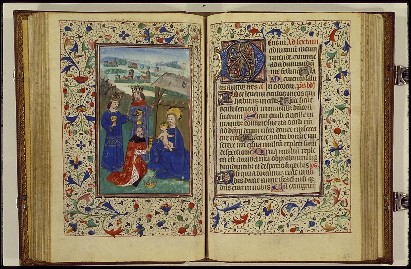
Example of Illuminated Bible

No comments:
Post a Comment